Modern fertility programs often begin with the plant… what nutrient is needed, what deficiency might appear and what product should be applied to correct it. But Glen’s framework has always pushed the question one step deeper. Before asking how to feed the plant, it’s worth asking whether the soil environment is capable of feeding the plant well in the first place.
That’s what it means to feed the soil before the plant.
A healthy crop depends on more than a fertilizer rate. It depends on a functioning soil system. Oxygen has to be present. Water has to move. Roots have to be able to explore. Microbes have to be active. Minerals have to be available in the right relationships, not just present on a report. When any one of those conditions breaks down, the efficiency of the whole system begins to fall with it.
This is where the idea becomes more than philosophy. Feeding the soil means building the physical and biological conditions that allow nutrient cycling to occur. In practical terms, that means improving pore space, maintaining the aerobic zone, supporting microbial diversity and keeping calcium available in the soil solution where roots and biology can use it. The goal is not simply to “add nutrients.” The goal is to create a soil environment where nutrients can be exchanged, mobilized and absorbed efficiently.
 That distinction matters. Soil can contain minerals and still function poorly. It can test high in certain nutrients and still produce a crop with weak roots, uneven growth and low resilience if the soil is tight, poorly aerated or biologically inactive. Glen’s broader teaching has always pointed back to soil function over simple input thinking: balance the mineral relationships, improve structure, increase oxygen and support the microbes that drive nutrient cycling. In that kind of system, the plant is no longer trying to survive around the soil environment. It’s growing with it.
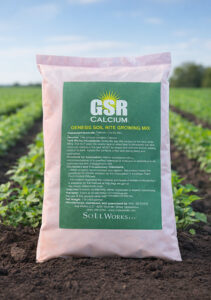
Calcium is central to that conversation because it helps shape the soil environment itself. Calcium can improve pore space, water infiltration, root development and soil structure, while also supporting mineral movement and plant function. That’s why available calcium is not just a plant nutrient in this framework. It’s part of how the soil is organized physically and biologically.
In that sense, feeding the soil before the plant doesn’t mean ignoring crop nutrition. It means taking a systems view of it. If the soil can breathe, cycle nutrients and support active biology, the plant has a far better chance to express its potential with fewer limitations and greater efficiency.
The question is not just: “What are you feeding this crop?” The better question may be: “What kind of soil environment are you asking this crop to grow in?”
